Projector – A Complete Introduction
Published: 31 Aug 2025
Imagine turning any plain wall in your room into a giant cinema screen within seconds. That’s exactly what happens when you understand what a projector is. This device brings pictures and videos to life by projecting them on a large surface, making your experience bigger and better. To learn more about devices that show results, check out our guide on output devices of a computer.
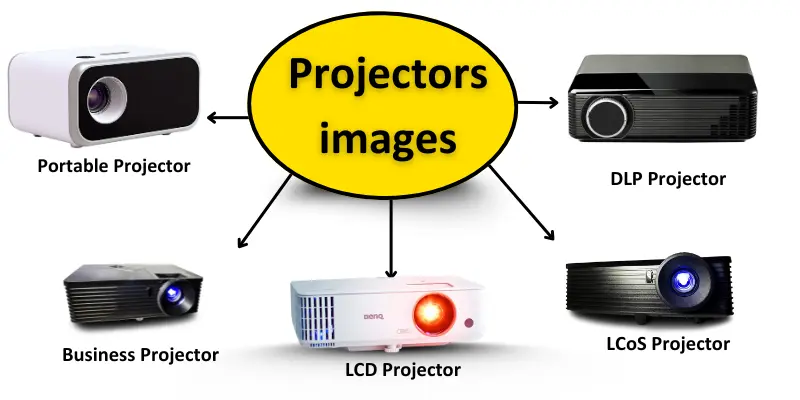
What is Projector?
A projector is a device that displays images or videos on a large surface, such as a wall or screen. It takes input from a computer, phone, or media player and projects it using light and lenses. People use projectors in classrooms, offices, and cinemas to share content with many viewers. In simple words, a projector makes small pictures big so everyone can see them clearly.
History of Projectors
Projectors were made a long time ago. People needed them to show pictures and stories to a big group instead of one person at a time.
Early History & Magic Lantern
In 1420, Johannes de Fontana drew a picture of a simple lantern that could show an image. In the 17th century, people made the Magic Lantern. It was the first real projector. It used a lamp and glass slides to put pictures on a wall.
Motion Pictures and Overhead Projectors
In 1853, a French scientist, Edmond Becquerel, made the first overhead projector. In the late 1800s, Eadweard Muybridge made the Zoopraxiscope. It showed moving pictures and was an early step to movie projectors.
The Digital Era
In the 1930s, people made the CRT projector. It was a big change in projector history. In the 1970s, they created the first digital projector. In the 1990s, digital projectors became common in schools, offices, and homes.
Modern Innovations
Today, projectors are smart and easy to use. Laser projectors make bright and clear images. Short-throw projectors can make big pictures even from a short distance. Many modern projectors are small, portable, and work with Wi-Fi.
Types of projectors
Projectors come in many types, each working differently and serving people in a unique way.
- Portable projector: People can easily carry it for movies or presentations anywhere.
- Business projector: It shows bright and clear images for meetings and offices.
- Home theater projector: It gives a big-screen movie experience at home.
- Short-Throw Projector: It projects large images from a short distance.
- LCD projector: It uses liquid crystal panels to show bright and clear pictures.
- LED projector: It uses LED lights, saves energy, and lasts longer.
- Laser projector: It produces very bright and colourful images for big rooms.
- DLP projector: It uses tiny mirrors to make sharp and clear pictures.
- 4K projector: It shows ultra-high-definition pictures for movies or games.
- LCoS projector: It uses Liquid Crystal on Silicon to make smooth and real images.
- CRT projector: It uses old cathode-ray tube technology to show pictures.
- Gaming projector: It shows fast and clear images for gaming.
- Projector TV: It functions like both a projector and a TV, offering big-screen viewing.
Parts of Projectors
A projector has many parts; each part helps it display pictures and videos on a large screen.
- Lens: Focuses and shows the image on the screen.
- Lamp/Light Source: Gives the light to make the picture bright.
- Colour Wheel: Adds colours to the picture.
- Cooling Fan: Prevents the projector from overheating.
- Power Supply: Gives power to the projector.
- Control Buttons: Used to start, stop, and adjust the projector.
- Ports/Connectors: Connect the projector to a computer, TV, or other device.
- Projector Body: Protects all internal components.
Uses of Projector
Projectors help people in many ways. They show pictures, videos, or presentations on a big screen so everyone can see clearly.
- In Education, Teachers use projectors to show lessons, videos, and presentations in classrooms.
- In Business, People use projectors for meetings, presentations, and training sessions.
- At Home: Families watch movies, play games, or enjoy big-screen shows at home.
- In Cinemas: Projectors show movies on very big screens for large audiences.
- At Events: People use projectors for conferences, weddings, and other big events.
Advantages and Disadvantages of a Projector
Projectors make small pictures big, so many people can see them at once. But like any device, projectors also have some disadvantages.
| Advantages |
|---|
|
| Disadvantages |
|---|
|
Conclusion
So guys, it’s time to finish up! In this article, we’ve covered the projector in detail. I personally recommend using a projector at home or in the classroom because it makes learning and watching movies more enjoyable. If you haven’t tried a projector yet, check one out today and enjoy a big-screen experience.
FAQs about the projector
Here are the important Questions about the projector.
A projector takes input from a computer, phone, or media player. It uses light and lenses to show the images on a big screen. The picture becomes bigger and easier to see for everyone.
Projectors can be portable, home theater, business, short-throw, LCD, LED, laser, DLP, 4K, LCoS, CRT, gaming, or projector TVs. Each type works differently for a special purpose. Some are small and easy to carry, while others are for big rooms.
LCD projectors use liquid crystals to show bright pictures. LED projectors use LED lights and save energy. DLP projectors use tiny mirrors to make sharp and clear images.
Yes, a projector can replace a TV for big-screen movies or shows. But it works best in a dark or low-light room. Some projectors are portable and easy to move around.
Projectors have brightness measured in lumens. A brighter projector works well in rooms with light. For dark rooms or home theaters, 1500–2500 lumens are enough.
Most projectors use HDMI, VGA, or USB cables. Some projectors also connect wirelessly using Wi-Fi or Bluetooth. Choose the method that matches your device and projector.
A projector shows large images for many viewers. It is good for movies, gaming, presentations, and learning. Some projectors are small, portable, and easy to use.

- Be Respectful
- Stay Relevant
- Stay Positive
- True Feedback
- Encourage Discussion
- Avoid Spamming
- No Fake News
- Don't Copy-Paste
- No Personal Attacks
- Be Respectful
- Stay Relevant
- Stay Positive
- True Feedback
- Encourage Discussion
- Avoid Spamming
- No Fake News
- Don't Copy-Paste
- No Personal Attacks
