Examples of Fifth Generation Computers With Pictures – You Should Know in 2026
Published: 25 May 2026
In 2026, computers have become far more advanced than ever before, moving beyond simple calculations to intelligent systems that can think, learn, and make decisions. The fifth generation of computers represents the most modern stage of computing, where artificial intelligence and smart technologies play a key role in solving real-world problems. These systems are faster, more powerful, and highly efficient compared to earlier generations, and they are widely used in areas like healthcare, robotics, space research, and automation.
In this guide, you will explore 15 examples of fifth generation computers with pictures and understand how these advanced technologies are shaping the future of the digital world.
You can also learn more about generations of computers for a better understanding of how computing has evolved over time.
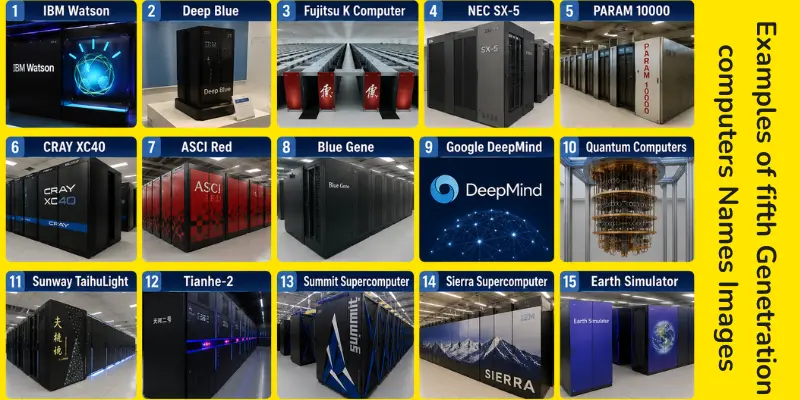
15 Examples of Fifth Generation Computers
Fifth-generation computers are modern smart systems that use artificial intelligence, automation, and advanced technologies to perform intelligent tasks.
Here is the list of the fifth generation of computer examples
- IBM Watson
- Deep Blue
- Fujitsu K Computer
- NEC SX-5
- PARAM 10000
- CRAY XC40
- ASCI Red
- Blue Gene
- Google DeepMind
- Quantum Computers
- Sunway TaihuLight
- Tianhe-2
- Summit Supercomputer
- Sierra Supercomputer
- Earth Simulator
Let’s explore these fifth generation of computer examples in detail.
IBM Watson
IBM Watson is an artificial intelligence system developed by IBM that processes large amounts of data and provides intelligent, human-like responses. IBM started its development around 2007, and the system became globally famous in 2011 when it defeated human champions in the quiz show Jeopardy!, proving the power of AI in real-world problem solving.
Features
IBM Watson is built on advanced AI technologies for intelligent data processing.
- Uses natural language processing to understand human language
- Applies machine learning to improve accuracy over time
- Processes large datasets in seconds for fast analysis
- Works on cloud-based architecture for scalable performance
- Supports advanced cognitive computing capabilities
Why was it developed?
IBM developed Watson to solve complex real-world problems using AI, especially where large data analysis and human-like understanding are required.
It is used for:
- Healthcare diagnosis support
- Business data analytics
- Customer service automation
- Scientific research analysis
IBM Watson shows how AI systems can support human intelligence through advanced computing.
2. Deep Blue
Deep Blue is a chess-playing supercomputer developed by IBM. Its development began in the late 1980s, and it became famous in 1997 when it defeated world chess champion Garry Kasparov in a six-game match. This was a major breakthrough in artificial intelligence and computer science because it showed that machines could compete with human intelligence in complex strategic games.
Features
Deep Blue was designed to calculate millions of possible chess moves in a very short time.
- It evaluates millions of chess positions per second
- It uses advanced parallel processing for fast calculations
- It applies decision-tree algorithms for move selection
- It is designed specifically for chess problem-solving
- It uses high-performance hardware for complex computations
Why was it developed?
IBM developed Deep Blue to test the power of artificial intelligence in strategic decision-making. The main goal was to create a system that could compete with, and potentially outperform, human intelligence in chess by analysing a large number of possible moves quickly and accurately.
It is used for:
- AI research in decision-making
- Development of modern game algorithms
- Parallel computing research
- Strategy-based AI modeling
Deep Blue proved that computers can outperform humans in specific intellectual tasks.
3. Fujitsu K Computer
The Fujitsu K Computer is a high-performance supercomputer developed by Fujitsu in Japan. Its development started in the late 2000s, and it became fully operational around 2011. It was one of the fastest supercomputers in the world at that time and was widely used for scientific research and complex simulations.
Features
The K Computer was designed to handle extremely large and complex calculations with high speed and accuracy.
- It uses parallel processing for massive computing tasks
- It contains hundreds of thousands of processor cores
- It delivers extremely high-speed performance for simulations
- It supports large-scale scientific data processing
- It is optimized for energy-efficient computing
Why was it developed?
Fujitsu developed the K Computer to solve advanced scientific and engineering problems that normal computers cannot handle. The goal was to support research in areas like climate modeling, earthquake prediction, and medical science.
It is used for:
- Weather and climate simulation
- Earthquake research
- Medical and drug discovery research
- Engineering simulation
The Fujitsu K Computer shows how fifth generation computing supports large-scale scientific discovery through powerful processing systems.
4. NEC SX-5
The NEC SX-5 is a vector supercomputer developed by NEC Corporation in Japan during the late 1990s. It was designed for high-speed scientific and engineering calculations and was widely used in research institutions for advanced computational tasks.
Features
NEC SX-5 was built for extremely fast numerical processing and large-scale simulations.
- It uses a vector processing architecture for fast calculations
- It supports high-speed scientific computing
- It is optimized for complex mathematical operations
- It handles large datasets efficiently
- It delivers stable performance for research applications
Why was it developed?
NEC developed the SX-5 to support scientists and engineers in solving complex mathematical and physical problems. The main goal was to improve computation speed for research areas that require heavy numerical calculations.
It is used for:
- Climate modeling
- Fluid dynamics simulations
- Physics and nuclear research
- Engineering design analysis
NEC SX-5 contributed to early high-performance computing development.
5. PARAM 10000
PARAM 10000 is a high-performance supercomputer developed by the Centre for Development of Advanced Computing (C-DAC) in India. It was introduced in 1998 and marked a major achievement in India’s computing technology. It was widely used for scientific research and engineering applications.
Features
PARAM 10000 was designed for fast and large-scale computations.
- It can perform billions of calculations per second (GigaFLOPS range)
- It uses multiple high-performance processors working in parallel
- It supports large distributed memory architecture
- It was built with a scalable cluster-based design
- It delivers high-speed scientific computing for research tasks
Why was it developed?
It was developed to strengthen India’s capability in supercomputing and to support advanced research in science, engineering, and defence sectors.
It is used for:
- Weather forecasting
- Scientific simulations
- Engineering applications
- Defense research
PARAM 10000 marks an important milestone in India’s entry into advanced computing.
6. CRAY XC40
CRAY XC40 is a high-performance supercomputer developed by Cray Inc. It was introduced in the 2010s and is used in advanced scientific research and large-scale simulations. It is known for its powerful processing speed and scalability.
Features
CRAY XC40 is designed for extreme computing performance.
- It delivers petascale-level performance (millions of billions of calculations per second)
- It uses a high-speed Aries interconnect system for fast communication
- It supports thousands of compute nodes in a single system
- It provides massively parallel processing architecture
- It is designed for high-performance scientific workloads and simulations
Why was it developed?
It was developed to solve complex scientific and engineering problems that require high computing power and fast processing speed.
It is used for:
- Climate research
- Scientific simulations
- Energy research
- Engineering analysis
CRAY XC40 is a powerful example of modern supercomputing used in advanced scientific fields.
7. ASCI Red
ASCI Red is a supercomputer developed by Intel and Sandia National Laboratories in the United States. It was introduced in 1996 and became the first computer to reach teraflop performance, making it a landmark in computing history.
Features
ASCI Red was built for extremely high-performance computing.
- It was the first supercomputer to cross 1 teraflop performance (1 trillion calculations per second)
- It contains over 9000 Intel processors working together
- It uses a massively parallel processing architecture
- It supports a high-speed distributed computing system
- It was designed for large-scale scientific and defence simulations
Why was it developed?
It was developed for the U.S. Department of Energy to perform advanced simulations, especially in nuclear research and national security projects.
It is used for:
- Nuclear simulation research
- Scientific computing
- Engineering analysis
- Defense modeling
ASCI Red played a key role in shaping modern supercomputing performance standards.
8. Blue Gene
Blue Gene is a family of supercomputers developed by IBM, first introduced in the early 2000s. It was designed to achieve extremely high performance while maintaining energy efficiency. It became widely known for its use in scientific and biological research.
Features
Blue Gene systems are designed for large-scale parallel computing.
- It achieved petaflop-level performance in advanced versions (quadrillions of calculations per second)
- It contains hundreds of thousands of processor cores
- It uses an ultra-high-density parallel processing design
- It provides low power consumption per computation unit
- It is optimized for large-scale scientific and biological simulations
Why was it developed?
IBM developed Blue Gene to support research that requires massive computing power, especially in biology, physics, and climate science.
It is used for:
- Biological research and protein folding
- Climate modeling
- Astrophysics simulations
- Large scientific computations
Blue Gene represents a major advancement in energy-efficient supercomputing technology.
9. Google DeepMind
Google DeepMind is an advanced artificial intelligence system developed by DeepMind Technologies and later acquired by Google in 2014. It focuses on building machines that can learn, reason, and solve complex problems using deep learning and neural networks.
Features
DeepMind is built on advanced AI architecture designed for self-learning and decision-making.
- Uses deep neural networks for complex pattern recognition
- Applies reinforcement learning for improving performance through feedback
- Processes large-scale datasets for advanced analysis
- Uses distributed computing for training large AI models
- Continuously improves accuracy through machine learning algorithms
Why was it developed?
Google DeepMind was developed to create intelligent systems that can learn from data and solve real-world problems without constant human guidance.
It is used for:
- Game AI systems like AlphaGo
- Healthcare research and disease prediction
- Energy optimization in data centers
- Scientific research and AI development
DeepMind represents a major step in artificial intelligence where machines can learn and improve like humans.
10. Quantum Computers
Quantum computers are advanced computing systems based on quantum physics principles. They use qubits instead of traditional binary bits and can perform highly complex calculations at extremely high speed.
Features
Quantum computers work on the principles of quantum mechanics for ultra-fast computation.
- Uses qubits instead of binary bits (0 and 1)
- Works on quantum superposition to handle multiple states at once
- Uses quantum entanglement for linked computations
- Performs massive parallel calculations naturally
- Solves specific complex problems much faster than classical computers
Why was it developed?
Quantum computers were developed to solve problems that are impossible or too slow for traditional computers.
They are used for:
- Drug discovery and molecular simulations
- Cryptography and security research
- Financial modeling and risk analysis
- Advanced scientific simulations
Quantum computing is considered the future of ultra-fast, powerful computing.
11. Sunway TaihuLight
Sunway TaihuLight is one of the world’s most powerful supercomputers, developed in China and operational since 2016. It is designed for large-scale scientific simulations and high-performance computing tasks.
Features
It is built for extreme computational power using millions of processing cores.
- Provides peak performance of over 125 petaflops (125 quadrillion calculations per second)
- Contains around 10.5 million processing cores
- Uses SW26010 many-core processor architecture
- Built with fully indigenous Chinese supercomputing technology
- Designed for massive parallel processing workloads
Why was it developed?
Sunway TaihuLight was developed to strengthen China’s supercomputing capabilities and support advanced scientific research.
It is used for:
- Weather and climate simulations
- Scientific and engineering research
- Industrial design and optimization
- Space and physics studies
Sunway TaihuLight is a powerful example of large-scale supercomputing used for solving real-world scientific problems.
12. Tianhe-2 (Milky Way-2)
Tianhe-2 is a high-performance supercomputer developed by the National University of Defense Technology (NUDT) in China. It was completed in 2013 and became one of the fastest supercomputers in the world for several years.
Features
Tianhe-2 is designed for extremely large-scale and high-speed scientific computing.
- Delivers a peak performance of about 33.86 petaflops
- Contains around 3.12 million processing cores
- Uses Intel Xeon processors combined with custom co-processors
- Built for massively parallel computing architecture
- Optimized for large scientific and engineering simulations
Why was it developed?
Tianhe-2 was developed to support China’s advanced research and national computing needs.
It is used for:
- Scientific simulations and research
- Weather forecasting and climate modeling
- Defense and security analysis
- Engineering and industrial calculations
Tianhe-2 shows how large-scale computing systems handle extremely complex scientific problems.
13. Summit Supercomputer
Summit is a powerful supercomputer developed by IBM for the Oak Ridge National Laboratory in the United States. It became operational in 2018 and is designed for advanced scientific research.
Features
Summit is built for high-performance computing with AI integration.
- Provides peak performance of around 200 petaflops
- Contains over 2.4 million CPU and GPU cores combined
- Uses IBM POWER9 processors with NVIDIA Tesla GPUs
- Designed for a hybrid CPU-GPU computing architecture
- Supports AI, machine learning, and simulation workloads
Why was it developed?
Summit was developed to solve complex scientific problems that require both high-speed computing and artificial intelligence.
It is used for:
- Cancer and medical research
- Climate and energy modeling
- Astrophysics and nuclear physics research
- Artificial intelligence and data science
Summit represents modern supercomputing where AI and traditional HPC work together.
14. Sierra Supercomputer
Sierra is a high-performance supercomputer developed by IBM and NVIDIA for Lawrence Livermore National Laboratory in the United States. It became operational in 2018 and is mainly used for national security research.
Features
Sierra is designed for highly secure and complex simulations.
- Delivers around 125 petaflops of performance
- Uses IBM POWER9 CPUs and NVIDIA V100 GPUs
- Contains hundreds of thousands of processing cores
- Built for hybrid CPU-GPU architecture
- Designed for highly reliable and secure computing
Why was it developed?
Sierra was developed to support nuclear security and advanced scientific simulations for the U.S. government.
It is used for:
- Nuclear weapons simulation (without physical testing)
- National security research
- Scientific and engineering modeling
- High-performance AI simulations
Sierra is a key example of secure and mission-critical supercomputing.
15. Earth Simulator
Earth Simulator is a supercomputer developed by Japan’s Earth Simulator Center and became operational in 2002. It was one of the fastest supercomputers in the world at that time.
Features
Earth Simulator is designed specifically for Earth and environmental science simulations.
- Delivers about 35.6 teraflops of performance
- Contains thousands of vector processing CPUs
- Built on a vector-based supercomputing architecture
- Optimized for climate and geoscience modelling
- Designed for large-scale environmental simulations
Why was it developed?
Earth Simulator was developed to study global environmental changes and improve the understanding of Earth systems.
It is used for:
- Climate change modelling
- Earthquake and tsunami research
- Ocean and atmospheric studies
- Environmental science simulations
Earth Simulator plays a major role in understanding Earth’s complex natural systems.
Conclusion
So, guys, in 2026, it’s clear that fifth-generation computers are not just advanced machines but intelligent systems transforming the way the world works. From AI-based systems like IBM Watson to powerful supercomputers like Blue Gene and Summit, all these examples show how technology has evolved to handle complex tasks with speed and accuracy. These systems are now essential in research, healthcare, defence, and scientific innovation, making modern life smarter and more efficient.
In my personal recommendation, if you are learning this topic, try to focus on understanding the real concept behind AI, supercomputing, and intelligent systems instead of just memorizing examples. This will help you stay up to date on 2026 technology trends and build a strong foundation for future studies in computer science.
For more computer guides, visit the website: computer guide hub
FAQs about the Fifth Generation of Computer Examples
The fifth generation of computers refers to modern intelligent systems that use artificial intelligence, machine learning, and advanced processing technologies to perform smart tasks like decision-making and problem-solving.
Common examples include IBM Watson, Deep Blue, Blue Gene, PARAM 10000, CRAY XC40, Fujitsu K Computer, and other advanced supercomputers used for research and AI development.
These computers use artificial intelligence, neural networks, parallel processing, quantum computing concepts, and machine learning technologies.
Yes, modern smartphones and AI assistants use fifth generation technology because they include artificial intelligence features, voice recognition, and smart automation systems.

- Be Respectful
- Stay Relevant
- Stay Positive
- True Feedback
- Encourage Discussion
- Avoid Spamming
- No Fake News
- Don't Copy-Paste
- No Personal Attacks
- Be Respectful
- Stay Relevant
- Stay Positive
- True Feedback
- Encourage Discussion
- Avoid Spamming
- No Fake News
- Don't Copy-Paste
- No Personal Attacks
