Sliding Window Protocol in Computer Networks
Published: 6 Jul 2026
Data transmission is an essential part of computer networks. Whenever devices communicate over a network, data must be delivered accurately and efficiently. However, sending one frame at a time can slow down communication and reduce network performance.
To solve this problem, computer networks use the Sliding Window Protocol. This protocol allows multiple data frames to be transmitted before receiving acknowledgments, thereby speeding up and improving the efficiency of communication.
In this article, you will learn what the Sliding Window Protocol is, how it works, its types, advantages, disadvantages, and applications in computer networks.
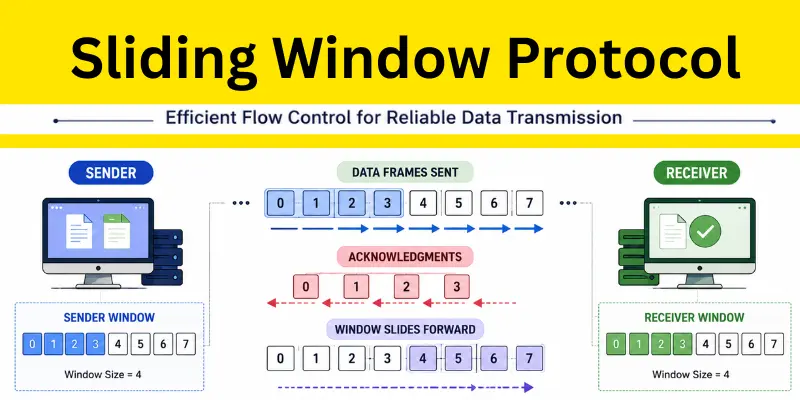
What is the Sliding Window Protocol in computer networks?
Sliding Window Protocol is a flow control protocol used in computer networks to manage the transmission of data between a sender and a receiver.
It allows the sender to transmit multiple frames before receiving acknowledgments for each one. Instead of waiting after every frame, the sender can continue sending data within a predefined window size.
This approach improves bandwidth utilization, reduces delays, and increases overall network efficiency.
Why Is Sliding Window Protocol Important?
The Sliding Window Protocol plays a vital role in ensuring efficient communication between devices.
Its importance includes:
- Improves data transmission speed
- Increases network throughput
- Reduces communication delays
- Makes better use of available bandwidth
- Supports reliable data delivery
- Enhances overall network performance
Without this protocol, data transmission would be slower because the sender would need to wait for acknowledgments after every frame.
How Does Sliding Window Protocol Work?
The Sliding Window Protocol uses a window that determines how many frames can be sent before receiving an acknowledgment.
The communication process works as follows:
- The sender transmits multiple frames based on the window size.
- The receiver receives the frames and sends acknowledgments.
- As acknowledgments arrive, the sender’s window moves forward.
- New frames are transmitted within the updated window.
- This process continues until all data is successfully delivered.
Because the window continuously moves forward, it is called a “sliding window.”
Key Components of Sliding Window Protocol
Several components work together to ensure smooth communication.
1. Sender Window
The sender window defines the number of frames that can be transmitted before acknowledgments are received.
2. Receiver Window
The receiver window specifies the number of frames the receiver can accept at a given time.
3. Sequence Numbers
Each frame is assigned a sequence number to help track its position and maintain the correct order.
4. Acknowledgments
Acknowledgments confirm that frames have been received successfully.
5. Window Size
The window size determines how many frames can be sent before waiting for acknowledgments.
A larger window size can improve throughput, while a smaller window size may reduce efficiency.
Types of Sliding Window Protocol
There are several protocols that use the sliding window concept.
1. Stop-and-Wait Protocol
Stop-and-Wait is the simplest flow control protocol.
In this method:
- The sender transmits one frame.
- The sender waits for an acknowledgment.
- After receiving the acknowledgment, the next frame is sent.
Although simple, this approach is less efficient because the sender spends a significant amount of time waiting.
2. Go-Back-N Protocol
Go-Back-N is an advanced sliding window protocol that allows multiple frames to be transmitted without waiting for individual acknowledgments.
If an error occurs in a frame:
- The receiver discards the erroneous frame and all subsequent frames.
- The sender retransmits the lost frame and all following frames.
Advantages of Go-Back-N include:
- Higher efficiency than Stop-and-Wait
- Better bandwidth utilization
- Simple implementation
3. Selective Repeat Protocol
Selective Repeat is another sliding window protocol that improves efficiency further.
If a frame is lost:
- Only the missing frame is retransmitted.
- Correctly received frames are stored and not discarded.
Advantages of Selective Repeat include:
- Reduced retransmissions
- Better performance
- Improved bandwidth utilization
Because fewer frames need to be resent, Selective Repeat is generally more efficient than Go-Back-N.
Example of Sliding Window Protocol
Suppose the window size is 4.
The sender can transmit:
- Frame 1
- Frame 2
- Frame 3
- Frame 4
without waiting for acknowledgments.
After receiving acknowledgments for Frames 1 and 2, the window slides forward, allowing the sender to transmit:
- Frame 5
- Frame 6
This process continues until all frames are successfully delivered.
The ability to send multiple frames simultaneously significantly improves communication speed.
Advantages of Sliding Window Protocol
Sliding Window Protocol offers several benefits:
- Improves network throughput
- Increases transmission efficiency
- Reduces waiting time
- Utilizes bandwidth effectively
- Supports reliable communication
- Enables continuous data transmission
- Improves overall network performance
These advantages make it one of the most widely used flow control mechanisms in computer networking.
Disadvantages of Sliding Window Protocol
Despite its benefits, the protocol has some limitations.
- More complex than Stop-and-Wait Protocol
- Requires additional memory for buffering
- Sequence number management can be challenging
- Retransmissions may increase network traffic in some situations
However, its advantages generally outweigh these limitations.
Applications of Sliding Window Protocol
Sliding Window Protocol is used in many networking environments.
Common applications include:
- TCP communication
- Internet data transfer
- Wireless networks
- Local Area Networks (LANs)
- Wide Area Networks (WANs)
- Satellite communication systems
- Data center networks
Its ability to improve efficiency makes it suitable for modern communication systems.
Sliding Window Protocol vs Stop-and-Wait Protocol
| Feature | Sliding Window Protocol | Stop-and-Wait Protocol |
| Data Transmission | Multiple frames at a time | One frame at a time |
| Efficiency | High | Low |
| Throughput | Better | Lower |
| Bandwidth Utilization | Efficient | Less efficient |
| Network Performance | Improved | Limited |
Common Challenges in Sliding Window Protocol
While the protocol improves efficiency, it may face several challenges:
- Lost frames
- Lost acknowledgments
- Network congestion
- Buffer overflow
- Transmission delays
Network protocols use error detection and recovery mechanisms to handle these challenges effectively.
How Sliding Window Protocol Improves Network Performance
The protocol improves network performance by allowing continuous data transmission instead of waiting after every frame.
Key improvements include:
- Faster communication
- Better bandwidth usage
- Reduced idle time
- Improved throughput
- More reliable data delivery
As a result, networks can transfer data more efficiently and support a larger number of users.
Conclusion
So guys, you should now have a clear understanding of the Sliding Window Protocol and its importance in computer networks. This protocol improves data transmission by allowing multiple frames to be sent before acknowledgments are received, making communication faster and more efficient.
Whether it is implemented through Go-Back-N or Selective Repeat, the Sliding Window Protocol helps increase throughput, reduce delays, and make better use of available bandwidth. These benefits make it an essential part of modern networking systems.
My recommendation is to focus on understanding the working process, window size, acknowledgments, and the differences between Go-Back-N and Selective Repeat rather than simply memorizing definitions. Once you understand how the protocol operates in real-world communication, networking concepts become much easier to learn and apply.

- Be Respectful
- Stay Relevant
- Stay Positive
- True Feedback
- Encourage Discussion
- Avoid Spamming
- No Fake News
- Don't Copy-Paste
- No Personal Attacks
- Be Respectful
- Stay Relevant
- Stay Positive
- True Feedback
- Encourage Discussion
- Avoid Spamming
- No Fake News
- Don't Copy-Paste
- No Personal Attacks
