Best Computer Courses in Demand for Beginners
Published: 22 Dec 2025
Are you confused about which computer course to choose for a bright and successful career? With so many options available online and offline, it’s easy to feel lost and unsure where to start. Many people spend months learning something that does not help them in the job market. That’s why we have prepared this guide on the top 10 computer courses in demand, so you can choose wisely and invest your time in courses that truly matter.
These courses cover the skills employers are actively seeking, from web development and AI to cybersecurity and cloud computing. By following this guide, you can focus on learning the right skills, avoid wasting time, and build a strong career in technology. With the right choice, you can confidently step into high-paying jobs and exciting opportunities.
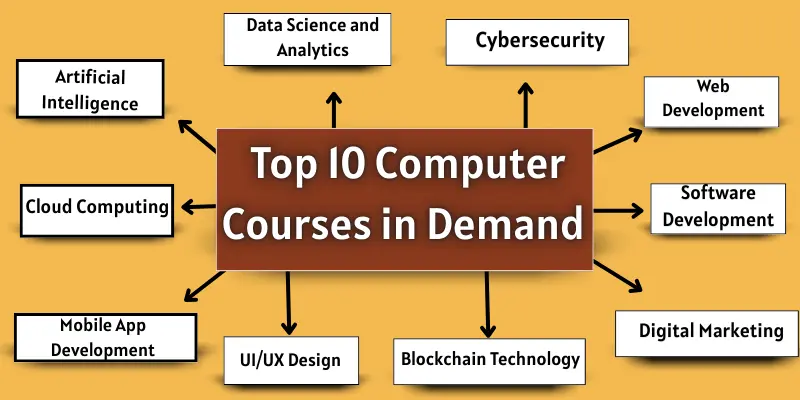
Top 10 computer courses in demand in world
Technology is growing fast, and learning the right skills can change your career. Here are the top 10 computer courses in demand that can help you succeed in the tech world.
- Data Science and Analytics
- Artificial Intelligence (AI) & Machine Learning
- Cybersecurity
- Cloud Computing
- Web Development
- Mobile App Development
- Software Development
- UI/UX Design
- Blockchain Technology
- Digital Marketing with Tech Focus
1. Data Science and Analytics
Data Science is the field of analyzing and understanding data to make smart decisions.
Key points:
- Helps businesses make data-driven decisions
- Involves collecting, cleaning, and interpreting data
- Combines statistics, programming, and domain knowledge
- Used in industries like finance, healthcare, and marketing
Tools & Languages
To work in Data Science, you need to know some important tools and languages:
- Python: for programming and data analysis
- R: for statistics and visualization
- SQL: to manage and query databases
- Excel: for basic data handling
- Tableau / Power BI: for data visualisation
Job Roles
Learning Data Science can lead to many exciting jobs:
- Data Analyst: interprets data and creates reports
- Data Scientist: builds models and predicts trends
- Business Analyst: uses data to improve business decisions
- Machine Learning Engineer: creates algorithms for AI
- Data Engineer: manages data systems and pipelines
2. Artificial Intelligence (AI) & Machine Learning
AI and Machine Learning enable computers to make decisions using data.
Key points:
- AI simulates human intelligence in machines
- Machine Learning allows systems to learn from experience
- Used in industries like healthcare, finance, and robotics
- Helps automate tasks and predict trends
Tools & Languages
To work in AI & Machine Learning, you need to know important tools and languages:
- Python: primary language for AI & ML projects
- R: for statistical modelling and analysis
- TensorFlow / PyTorch: frameworks for building ML models
- SQL: to manage and query data
- Jupyter Notebook: for experimentation and visualization
Job Roles
AI & Machine Learning open doors to many exciting careers:
- Machine Learning Engineer: builds ML models and algorithms
- AI Developer: creates AI applications and solutions
- Data Scientist: applies ML to analyze and predict trends
- Deep Learning Engineer: works on neural networks and AI models
- Business Intelligence Developer: uses AI insights for decision-making
3. Cybersecurity
Cybersecurity protects computers, networks, and data from cyber attacks and unauthorized access.
Key points:
- Keeps sensitive information safe
- Prevents hacking and malware attacks
- Important for businesses, governments, and individuals
- Helps maintain privacy and trust online
Tools & Languages
To work in Cybersecurity, you need to know some important tools and languages:
- Python: for automation and scripting
- Wireshark: to monitor network traffic
- Nmap: for network scanning and security testing
- Kali Linux: a platform for ethical hacking
- SQL: to understand database security
Job Roles
Cybersecurity offers many high-demand job opportunities:
- Ethical Hacker: finds and fixes security weaknesses
- Security Analyst: monitors and protects systems
- Security Consultant: advises companies on security measures
- Penetration Tester: tests systems for vulnerabilities
- Network Security Engineer: designs secure network systems
4. Cloud Computing
It helps you store and access data and programs online instead of on your computer.
Key points:
- Provides on-demand computing resources
- Reduces the need for physical hardware
- Supports remote work and collaboration
- Used by companies of all sizes
Tools & Platforms
To work in Cloud Computing, you should know these tools and platforms:
- AWS (Amazon Web Services): cloud services for computing and storage
- Microsoft Azure: A platform for cloud solutions and services
- Google Cloud Platform: cloud computing for businesses
- Docker / Kubernetes: tools for containerization and deployment
- Linux: often used in cloud environments
Job Roles
Cloud Computing opens up many career opportunities:
- Cloud Engineer: designs and manages cloud infrastructure
- DevOps Engineer: handles deployment and operations
- Cloud Architect: plans cloud strategies for companies
- Cloud Consultant: advises businesses on cloud solutions
- Site Reliability Engineer (SRE): ensures cloud systems run smoothly
5. Web Development
It is the process of creating websites and web applications that users can interact with online.
Key points:
- Builds websites, apps, and online platforms
- Includes both design and coding
- Important for businesses, startups, and e-commerce
- Helps improve user experience and functionality
Tools & Languages
To work in Web Development, you should know these tools and languages:
- HTML: for creating web pages
- CSS: for styling websites
- JavaScript: to make websites interactive
- React / Angular / Vue: frameworks for front-end development
- Node.js / PHP / Python: for back-end development
Job Roles
Web Development offers many exciting career options:
- Front-End Developer: creates the user interface and design
- Back-End Developer: manages server, database, and application logic
- Full-Stack Developer: works on both front-end and back-end
- Web Designer: focuses on layout and visual appeal
- UI/UX Developer: improves user experience on websites and apps
6. Mobile App Development
It is the process of creating apps for smartphones and tablets that people can use.
Key points:
- Builds apps for Android and iOS devices
- Helps businesses reach users on mobile
- Includes coding, design, and testing
- Used in gaming, social media, finance, and more
Tools & Languages
To work in Mobile App Development, you should know these tools and languages:
- Java / Kotlin: for Android app development
- Swift: for iOS app development
- Flutter: framework for cross-platform apps
- React Native: for building apps on both platforms
- Android Studio / Xcode: development environments
Job Roles
Mobile App Development offers many career opportunities:
- Android Developer: creates apps for Android devices
- iOS Developer: develops apps for iPhones and iPads
- Flutter / React Native Developer: builds cross-platform apps
- App Designer: focuses on user interface and experience
- Mobile QA Tester: tests apps for bugs and performance issues
7. Software Development
It is the process of creating programs that help computers perform specific tasks.
Key points
- Builds applications, programs, and systems
- Includes coding, testing, and maintenance
- Used in businesses, games, and everyday tools
- Helps automate tasks and solve problems
Tools & Languages
To work in Software Development, you should know these tools and languages:
- Java: a popular language for apps and software
- Python: used for apps, automation, and AI
- C#: for Windows applications and games
- C++: for system software and high-performance apps
- Git / GitHub: for version control and collaboration
Job Roles
Software Development offers many career options:
- Software Developer: creates applications and programs
- Software Engineer: designs and develops complex systems
- Backend Developer: manages server and database functions
- Full-Stack Developer: works on both front-end and back-end
- QA Tester: tests software for bugs and errors
8. UI/UX Design
UI/UX Design focuses on creating websites and apps that are easy and enjoyable to use.
Key points
- UI (User Interface) is about how things look
- UX (User Experience) is about how things feel
- Improves user satisfaction and engagement
- Important for websites, apps, and software
Tools & Languages
To work in UI/UX Design, you should know these tools:
- Figma: for designing user interfaces
- Adobe XD: for creating prototypes
- Sketch: design tool for Mac users
- InVision: for interactive design and collaboration
- HTML / CSS (basic): helps understand web design
Job Roles
UI/UX Design offers many career opportunities:
- UI Designer: creates visually appealing interfaces
- UX Designer: improves the user experience
- Product Designer: combines UI and UX for products
- Interaction Designer: focuses on user interaction
- UX Researcher: studies user behavior and feedback
9. Blockchain Technology
Blockchain is a system that records transactions securely and transparently across multiple computers.
Key points:
- Ensures secure and tamper-proof data
- Used in cryptocurrency, finance, and supply chain
- Helps track transactions and ownership
- Supports decentralized applications
Tools & Languages
To work in Blockchain Technology, you should know these tools and languages:
- Solidity: a programming language for smart contracts
- Ethereum: a platform for building blockchain apps
- Hyperledger: framework for enterprise blockchain
- Python / JavaScript: for blockchain development
- Truffle / Ganache: tools for testing and deploying contracts
Job Roles
Blockchain Technology offers many career opportunities:
- Blockchain Developer: builds blockchain applications
- Smart Contract Developer: creates automated contracts
- Blockchain Consultant: advises businesses on blockchain solutions
- Crypto Analyst: studies cryptocurrency markets
- Blockchain Architect: designs blockchain systems and frameworks
10. Digital Marketing with Tech Focus
Digital Marketing uses online tools and technology to promote products and services.
Key points:
- Reaches customers through websites, social media, and email
- Uses data and analytics to improve campaigns
- Helps businesses grow online
- Important for all industries
Tools & Platforms
To work in Digital Marketing, you should know these tools and platforms:
- Google Analytics: It tracks website traffic and user behaviour
- SEO tools (Ahrefs, SEMrush): improve search engine ranking
- Social Media Platforms (Facebook, Instagram, LinkedIn): for promotion
- Email Marketing Tools (Mailchimp, Sendinblue): for campaigns
- Ad Platforms (Google Ads, Meta Ads): for paid advertising
Job Roles
Digital Marketing offers many career opportunities:
- Digital Marketer: plans and executes online campaigns
- SEO Specialist: optimizes websites for search engines
- Social Media Manager: manages social platforms
- Content Marketer: creates engaging content
- PPC Specialist: manages paid online ads
Additional High-Value Computer Courses to Consider
Apart from the top 10 computer courses in demand, many other courses also offer great career opportunities. These courses help you build strong technical skills and give you more options to grow in the IT field.
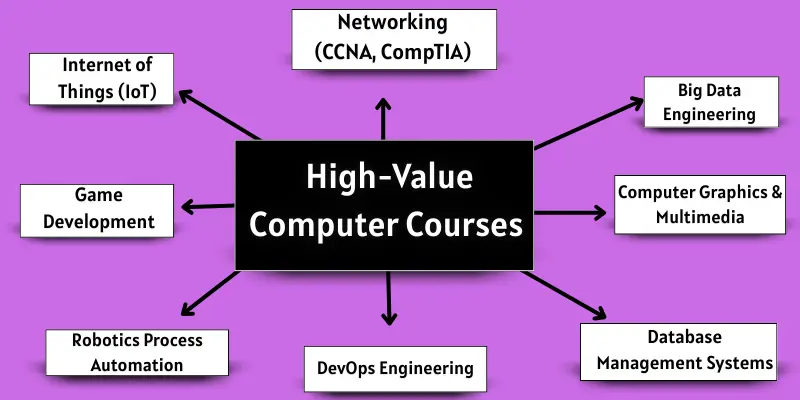
- Networking (CCNA, CompTIA)
- Internet of Things (IoT)
- Big Data Engineering
- Game Development
- Robotics Process Automation (RPA)
- DevOps Engineering
- Database Management Systems
- Computer Graphics & Multimedia
1. Networking (CCNA, CompTIA)
Networking is about connecting computers so they can share data and resources easily.
Key points:
- Helps computers communicate with each other
- Important for internet and office networks
- Used in companies, schools, and data centers
- Builds a strong IT foundation
Tools & Languages:
To work in Networking, you should learn these tools and skills:
- Cisco Packet Tracer: for network practice and simulations
- Wireshark: for checking network traffic
- Linux: for server and network management
- Python: for network automation
- TCP/IP: basic networking protocol
Job Roles:
Networking skills open many career paths:
- Network Administrator: manages daily network operations
- Network Engineer: designs and installs networks
- IT Support Engineer: solves network issues
2. Internet of Things (IoT)
It connects everyday devices to the internet so they can work smarter together.
Key points:
- Connects devices like sensors, cameras, and machines
- Used in smart homes, smart cities, and industries
- Helps automate daily tasks
- Combines hardware and software skills
Tools & Languages
To work in IoT, you should learn these tools and skills:
- Arduino: for building IoT hardware projects
- Raspberry Pi: for smart device development
- Python: for programming IoT systems
- C / C++: for embedded systems
- MQTT: for device communication
Job Roles
IoT skills create many career opportunities:
- IoT Developer: builds IoT applications
- IoT Engineer: manages connected systems
- Embedded Systems Engineer: works with hardware and software
- IoT Consultant: helps businesses use IoT solutions
3. Big Data Engineering
Big Data Engineering focuses on managing and processing very large amounts of data.
Key points:
- Handles huge data from different sources
- Helps companies analyze data faster
- Supports business decisions and planning
- Used in tech, finance, and healthcare
Tools & Languages
To work in Big Data Engineering, you should learn these tools and skills:
- Hadoop: for storing and processing big data
- Apache Spark: for fast data processing
- Python: for data handling and analysis
- SQL / NoSQL: for managing databases
- Kafka: for real-time data streaming
Job Roles
Big Data Engineering offers many career options:
- Big Data Engineer: builds and manages data systems
- Data Engineer: prepares data for analysis
- Data Analyst: analyzes large datasets
- Data Architect: designs data structures
4. Game Development
Game Development is the process of creating interactive and engaging video games.
Key points:
- Combines creativity and programming
- Used for PC, mobile, and console games
- Includes design, coding, and testing
- Popular in entertainment and education
Tools & Languages
To work in Game Development, you should learn these tools and skills:
- Unity: popular game development engine
- Unreal Engine: advanced game engine
- C#: widely used with Unity
- C++: used for high-performance games
- Blender: for 3D models and animations
Job Roles
Game Development offers many career paths:
- Game Developer: builds and codes games
- Game Designer: creates game concepts and rules
- 3D Artist: designs characters and environments
- Game Tester: tests games for bugs
5. Robotics Process Automation (RPA)
It is a software robots to automate repetitive and rule-based tasks.
Key points:
- Reduces manual work and human errors
- Saves time and increases productivity
- Used in banking, HR, and IT sectors
- Helps businesses work faster
Tools & Languages
To work in RPA, you should learn these tools and skills:
- UiPath: popular RPA platform
- Automation Anywhere: enterprise automation tool
- Blue Prism: RPA software for businesses
- Python: for advanced automation
- Excel / SQL: for data handling
Job Roles
RPA skills create many job opportunities:
- RPA Developer: builds automation bots
- RPA Analyst: analyzes processes for automation
- Automation Engineer: designs automated workflows
- Business Analyst: connects automation with business needs
6. DevOps Engineering
DevOps Engineering combines development and operations to deliver software faster and better.
Key points:
- Improves teamwork between developers and IT teams
- Speeds up software development and deployment
- Reduces errors and system downtime
- Used by tech companies and startups
Tools & Languages
To work in DevOps Engineering, you should learn these tools and skills:
- Docker: for containerization
- Kubernetes: for managing containers
- Jenkins: for continuous integration
- Linux: for server management
- Python / Shell Scripting: for automation
Job Roles
DevOps Engineering offers strong career options:
- DevOps Engineer: manages development and deployment
- Site Reliability Engineer (SRE): ensures system stability
- Release Engineer: handles software releases
- Cloud DevOps Engineer: manages cloud infrastructure
7. Database Management Systems (DBMS)
DBMS helps store, organize, and manage data in a secure and structured way.
Key points:
- Keeps data safe and easy to access
- Used by websites, apps, and businesses
- Helps manage large amounts of information
- Supports data backup and recovery
Tools & Languages
To work in DBMS, you should learn these tools and skills:
- MySQL: popular relational database
- PostgreSQL: advanced open-source database
- Oracle Database: enterprise-level DBMS
- SQL: a language for managing databases
- MongoDB: NoSQL database for large data
Job Roles:
DBMS skills open many career opportunities:
- Database Administrator: manages and maintains databases
- SQL Developer: writes and optimizes database queries
- Data Engineer: works with data systems
- Backend Developer: handles database operations
8. Computer Graphics & Multimedia
Computer Graphics & Multimedia focuses on creating visual content and interactive media using computers.
Key points:
- Designs images, animations, and videos
- Used in games, movies, and advertisements
- Combines creativity and technical skills
- Enhances communication and storytelling
Tools & Languages
To work in Computer Graphics & Multimedia, you should learn these tools and skills:
- Adobe Photoshop: for image editing
- Adobe Illustrator: for vector graphics
- Blender / Maya: for 3D modelling and animation
- After Effects: for motion graphics and visual effects
- HTML / CSS (basic): for web-based multimedia
Job Roles
Computer Graphics & Multimedia offers many career paths:
- Graphic Designer: creates visuals for marketing and media
- 3D Artist: designs 3D models and animations
- Animator: produces animated videos and films
- Multimedia Specialist: combines graphics, audio, and video for projects
How to Choose the Right Computer Course
Choosing the right computer course is very important for your career. The right course can help you learn the skills that companies need and open doors to high-paying jobs. Before picking a course, it’s important to think about your goals, the tools and languages you want to learn, and the kind of jobs you are aiming for. A good course should not only teach theory but also give practical experience so you can work confidently in the real world.
Key points to consider:
- Identify Your Goal: Know what career or job you want
- Check Course Content: Make sure it covers the skills you need
- Look at Tools & Languages: Learn the most used tools in the industry
- Consider Job Opportunities: Pick courses with high-demand jobs
- Certification & Recognition: Choose courses recognized by companies
- Time & Budget: Ensure the course fits your schedule and budget
- Hands-on Practice: Practical experience is important for real skills
Conclusion
So, guys, I hope you have learned and understood a lot from this guide. In this post, we covered the Top 10 computer courses in demand. I recommend starting with a course that matches your interests and career goals, because learning becomes easier and more enjoyable when you’re engaged. Don’t wait, choose a course today and start building your bright future in the IT world!
FAQs about computer courses
These are the most common questions people ask about computer skills.
For beginners, courses like Data Science, Web Development, or Digital Marketing are great starting points. They teach basic skills and are in high demand. You can gradually move to advanced courses once you feel confident.
The duration depends on the course and your learning pace. Some courses take a few weeks, while others may take several months. It’s better to focus on learning skills properly rather than rushing.
Yes, most of these courses are available online. Platforms like Coursera, Udemy, and edX offer beginner-friendly courses. You can learn from home at your own pace.
Most courses do not require prior experience, especially beginner-level ones. They start with basic concepts and gradually move to advanced topics. You just need interest and dedication to learn.
Courses like Data Science, Cybersecurity, Cloud Computing, and Web Development have high job demand. These fields are growing rapidly in the IT industry. Choosing them increases your chances of getting a good job.
Yes, most courses provide a certificate after completion. Certificates help showcase your skills to employers. Some recognized platforms offer globally accepted certificates for better opportunities.
Yes, many IT jobs allow remote work. Skills such as Web Development, Digital Marketing, and Cloud Computing are highly valued in remote positions. Learning these courses increases your chances of working from home or anywhere.
It depends on your course. For example, Python is important for Data Science, while HTML, CSS, and JavaScript are essential for Web Development. Focus on the main tools first and gradually explore advanced ones.

- Be Respectful
- Stay Relevant
- Stay Positive
- True Feedback
- Encourage Discussion
- Avoid Spamming
- No Fake News
- Don't Copy-Paste
- No Personal Attacks
- Be Respectful
- Stay Relevant
- Stay Positive
- True Feedback
- Encourage Discussion
- Avoid Spamming
- No Fake News
- Don't Copy-Paste
- No Personal Attacks
