Elements of Transport Protocol in Computer Networks
Published: 4 Jul 2026
Data communication would be unreliable without transport protocols. When information travels across a network, it must reach the correct destination, remain error-free, and arrive in the proper order. This is where transport protocols play an important role.
Transport protocols use several elements to manage data transmission between devices. These elements help ensure reliable communication, control network traffic, detect errors, and deliver data efficiently.
In this article, you will learn the key elements of transport protocol in computer networks, their functions, and how they work together to support end-to-end communication.
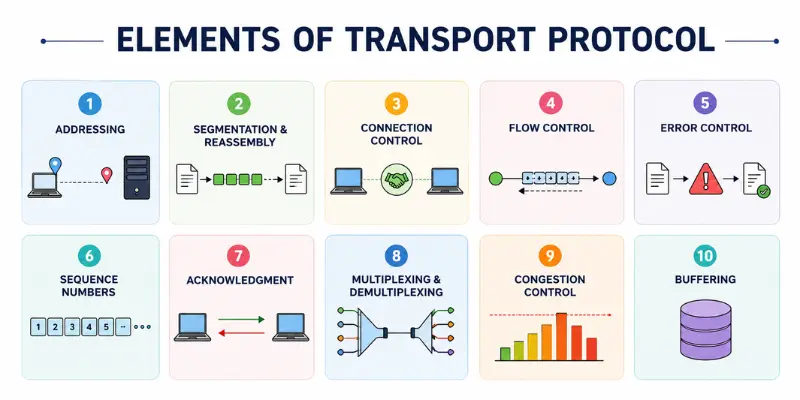
What Are the Elements of Transport Protocol in Computer Networks?
The main elements of transport protocol in computer networks are addressing, segmentation and reassembly, connection control, flow control, error control, sequence numbers, acknowledgment, multiplexing and demultiplexing, congestion control, and buffering.
These elements work together to ensure reliable, organized, and efficient communication between devices on a network.
1. Addressing
Addressing enables process-to-process communication between devices. The transport layer uses port numbers to identify the sending and receiving applications.
For example, when you open a website, the transport protocol uses port numbers to ensure that the data reaches the correct application on your device.
2. Segmentation and Reassembly
Large messages are divided into smaller segments before transmission. This process is known as segmentation.
When the segments arrive at the destination, they are combined again to recreate the original message. This process is called reassembly.
Segmentation improves transmission efficiency and makes data easier to manage across a network.
3. Connection Control
Connection control determines how communication is established between devices.
It can be:
- Connection-oriented communication
- Connectionless communication
This element manages the setup, maintenance, and termination of communication sessions between devices.
4. Flow Control
Flow control regulates the rate at which data is transmitted between sender and receiver.
Its purpose is to prevent the receiver from becoming overwhelmed by receiving data faster than it can process.
Flow control helps maintain smooth and efficient communication.
5. Error Control
Error control ensures that data is transmitted accurately from the sender to the receiver. During transmission, data may become corrupted, lost, or duplicated due to network issues.
To maintain reliability, the transport protocol detects errors and takes corrective actions when necessary. If an error is detected, the affected data can be retransmitted.
The main benefits of error control include:
- Improved data accuracy
- Reliable communication
- Reduced data loss
- Better network performance
6. Sequence Numbers
Sequence numbers help keep track of data segments during transmission.
Each segment is assigned a unique number before being sent across the network. These numbers allow the receiver to identify missing segments and arrange the received data in the correct order.
Sequence numbers help:
- Maintain data order
- Detect missing segments
- Support error recovery
- Improve communication reliability
7. Acknowledgment
Acknowledgment is a mechanism that confirms that data has been received successfully.
When the receiver gets a data segment, it sends an acknowledgment message back to the sender. If the sender does not receive the acknowledgment within a specific time, it may retransmit the data.
Acknowledgment helps ensure:
- Reliable data delivery
- Error detection
- Successful communication
- Reduced data loss
8. Multiplexing and Demultiplexing
Multiplexing allows multiple applications to send data over a single communication channel simultaneously.
At the receiving end, demultiplexing separates the incoming data and delivers it to the correct application.
For example, a user can browse the internet, stream a video, and download a file at the same time because the transport layer correctly manages and directs the data.
Benefits include:
- Efficient use of network resources
- Support for multiple applications
- Improved communication management
9. Congestion Control
Congestion control helps prevent excessive traffic from overwhelming the network.
When too much data is transmitted at the same time, network performance can decrease, leading to delays and packet loss. Congestion control mechanisms regulate data transmission to maintain stable communication.
Its main objectives are:
- Prevent network overload
- Reduce packet loss
- Improve transmission efficiency
- Maintain network stability
10. Buffering
Buffering involves temporarily storing data before it is processed or transmitted.
Buffers help manage differences in data transmission speeds between devices and ensure smooth communication.
Buffering provides several advantages:
- Reduced transmission delays
- Better flow management
- Improved data handling
- Enhanced communication efficiency
How These Elements Work Together
The elements of a transport protocol do not work independently. They cooperate to provide reliable and efficient data communication.
A typical communication process works as follows:
- Data is generated by an application.
- The transport layer divides the data into segments.
- Sequence numbers are assigned to each segment.
- Flow control regulates transmission speed.
- Error control checks for transmission problems.
- Acknowledgments confirm successful delivery.
- Segments are reassembled at the destination.
- The data is delivered to the correct application through demultiplexing.
Together, these elements ensure that data reaches its destination accurately and in the correct order.
Functions of Transport Protocol
The transport protocol performs several important functions that support network communication:
- End-to-End Communication: Provides direct communication between applications running on different devices.
- Reliable Data Transfer: Ensures that data reaches the destination without unnecessary loss or corruption.
- Error Recovery: Detects transmission errors and initiates corrective actions when needed.
- Data Sequencing: Ensures that data is received in the same order in which it was sent.
- Flow Management: Balances data transmission between the sender and receiver.
Real-World Example of Transport Protocol Elements
Consider a user opening a website in a web browser.
The communication process involves several transport protocol elements:
- Addressing identifies the browser application.
- Segmentation divides the webpage data into smaller segments.
- Sequence numbers track the order of segments.
- Flow control manages the transmission rate.
- Error control checks for transmission errors.
- Acknowledgments confirm successful delivery.
- Reassembly combines the segments into the complete webpage.
Without these elements, webpages might load incorrectly, slowly, or not at all.
Advantages of Transport Protocol Elements
The elements of transport protocols provide several benefits:
- Reliable communication
- Accurate data delivery
- Efficient network utilization
- Better traffic management
- Reduced transmission errors
- Improved user experience
These advantages make transport protocols essential for modern computer networks.
Challenges of Transport Protocols
Despite their benefits, transport protocols face several challenges.
Common challenges include:
- Network congestion
- Packet loss
- Communication delays
- Bandwidth limitations
- High traffic volumes
Transport protocols use various mechanisms to minimize the impact of these challenges and maintain stable communication.
Conclusion
So, guys, you have hopefully understood the elements of transport protocols in computer networks and their role in ensuring smooth data transmission. From addressing and segmentation to flow control and error control, each element contributes to reliable end-to-end communication.
Transport protocols are a vital part of networking because they help manage data delivery, maintain accuracy, and reduce communication errors. Without these elements, modern internet communication would not be as reliable as it is today.
As a recommendation, students and beginners should not only learn the definitions of these elements but also understand their practical applications. This approach will make networking concepts easier to understand and remember in the long run.
FAQs about transport protocol elements
A transport protocol ensures reliable end-to-end communication between devices by managing data transmission, error handling, and flow control.
Flow control prevents the receiver from becoming overloaded by regulating the rate of data transmission.

- Be Respectful
- Stay Relevant
- Stay Positive
- True Feedback
- Encourage Discussion
- Avoid Spamming
- No Fake News
- Don't Copy-Paste
- No Personal Attacks
- Be Respectful
- Stay Relevant
- Stay Positive
- True Feedback
- Encourage Discussion
- Avoid Spamming
- No Fake News
- Don't Copy-Paste
- No Personal Attacks
